

A Discussion with Alex Hanna, Author of the AI CON: Addressing the AI Hype and Implications for All of Us!
A Synopsis of Alex Hanna's conversation with Dr. M. Murphy, in Toronto June 18th, 2026


I had the pleasure of attending this event yesterday. Following the news of Musk’s recent IPO, the clear craziness of the level of investment in these AI labs and the shift in the public’s response to the impacts these technologies are having today, reveals this dichotomy: investment is either blind to public perception and outrage, or it is quick to discount the needs of humanity.
I believe their bets on the whims of these tech bros are more about FOMO and earnings than about believing these companies are sustainable. The grift truly runs deep.
Dr. M. Murphy moderated the session. M. Murphy is a technoscience studies scholar who theorizes and researches environmental justice; reproductive justice; Indigenous science, infrastructures, and data studies; racial capitalism; and the Great Lakes.
Alex Hanna is the Director of Research at the Distributed AI Research Institute (DAIR). She also co-authored The AI CON with Emily Bender, which began as part of the Mystery AI Hype Theatre 3000 series, which “tears apart the AI Hype” on their live stream and podcast.
“AI is a Marketing Term”
The ‘boosters’ and ‘doomsters’ exist today and emerge from the impacts that people have personally experienced or knowledge they’ve obtained. In between is a “panic” to get on the bandwagon for fear of being displaced… for businesses, it’s the pressure to keep pace with technology and adopt it quickly… or else.
Even before ChatGPT launched, Bender and Hanna recognized the optimism about AI on Twitter/X. Despite this, there were also a lot of hiccups, flaws, and clear errors that arose from AI. They started to make fun of these flaws:
Some great vids from their podcast:
Uber for Military Surveillance
Hanna clarifies that AI is a marketing term that can refer to many different things. She advises that we need to treat each specific automated tool differently, “disaggregate AI” rather than treating it as one intelligence force. She clarifies and provides some differences:
Automated decision-making systems (ADS) are useful for pre-trial risk assessment, policing, hiring, and automated loan adjudication.
A superset of those includes classification or determination of whether something fits within a given category. This manifests in recommendation systems that rely on what you engage with and consume on social or retail sites.
Generative AI - she describes as entities that precede the automation, translating it from one format to another, e.g. letters in an image transcribed into letters, which enable automatic speech recognition.
As Hanna states,
“The problem with calling it all Artificial Intelligence is that it makes us think that if the technology can do one thing well—in one case outputting believable-sounding or procurement-sounding text from a prompt—then it can do other things well… So it can do math or operate as some kind of oracle. So it’s helpful to create some distance from the term.”
The Forms of Hype
Hanna refers to the pervasive use of anthropomorphic labels like AI tutor, AI secretary—technology that can replace critical occupations or critical parts of social practice. It’s ramping up in the medical field. In academic terms, now common terms like the automated technical researcher or scientist are cropping up. What’s problematic, especially in medical or social services, are the patient interventions that will be displaced.
In addition, the gender-specific labels describing the type of work to be replaced include “secretarial, maternal, AI girlfriends.” The impact includes the justification for AI companionship. She also alludes to Geoff Hinton’s recent remarks that we need to train these technologies to be more maternal or “risk extinction.”
Hinton said this:
“Where's an example of a more intelligent thing being controlled by a less intelligent thing?” The best example I know of, and perhaps the only one in the sense we're talking about, is how a baby controls a mother, and that's because evolution built stuff into the mother.
She can't bear the sound of the baby crying. She gets all sorts of hormonal rewards from being nice to the baby. It was very important, obviously, for evolution to let the baby control the mother for the survival of the species.
Maybe we can do the same with AI. Even though it's going to be smarter than us, if we could make it care more about us than it did about itself, there's some good things that would come out of that.
In addition, part of the hype is driven by strong market players like Allbirds, a maker of premium canvas sneakers, which went bankrupt, then became SmartBirds, an AI company, and later became a strong arbiter of AI hardware. Starbucks also recently launched their “groundbreaking” AI platform to boost its faltering sales performance. The political economy is enabling these companies to pivot with the promise of better returns. The brand elevation by these companies continues to fuel AI hype.
AI Will Displace Us!
Murphy pointed out:
There are doomsayers, like Geoff Hinton, who say AI is an existential crisis and AI robots will take over everything… They’ll be so much smarter than us that we’ll be unemployed…
But if you don’t buy into the scare that you need to get trained immediately or else get left behind, I often find that what’s left in the middle is pragmatism.
What that middle ground suggests is a justice-based argument. Hanna says that this AI discussion has shifted the Overton window, where you either think about “AI boosterism” or “AI doomerism.”
Doomerism she defines as existential risk, and robots-will-kill-us-all-type messaging. But it also encompasses death because of job displacement and loss of purpose, as she explains, that this middle of the road often gives us statements like, “AI is just a tool.” She asserts that science or technology scholars will argue that this is rage-baiting, alluding to STS 101: sociotechnical systems emphasize that tech systems must be jointly optimized through collaborative design between the social (people, organizations, and culture) and the machine, software, and technical systems.
These AIs are “not just tools;” they are not neutral but are designed in specific ways to elicit specific outcomes.
Emily Bender in a recent episode said this:
The boosters say AI is a thing. It's inevitable, it's imminent, it's going to be super powerful, and it's going to solve all of our problems. And the doomers say AI is a thing, it's inevitable, it's imminent, it's going to be super powerful, and it's going to kill us all. And you can see that there's actually not a lot of daylight between those two positions, despite the discourse of saying these are two opposite ends of a spectrum.
What sometimes gets misinterpreted, as per Hanna, is the notion that she is perceived as an AI extremist. She argues her position is not extreme, but rather “incredibly boring.” She adds that the general public, however, is weighing in on AI:
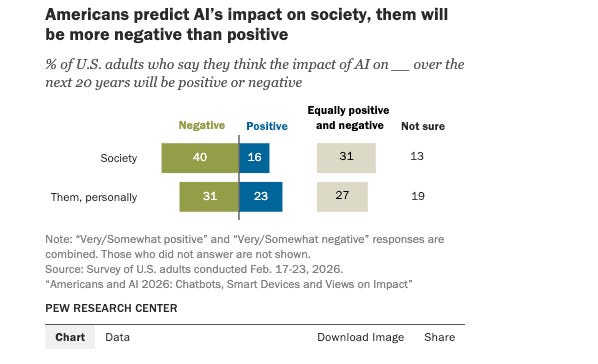
I looked at recent polling in the US around AI decisions. 16% of people will see chatbots as a net positive. In fact, in the US, chatbots are less popular than ICE.
But the perception of AI extremism reflects the point of view from the “AI boosters,” who see ethics and human-centred experts like Hanna as constantly scrutinizing and calling out the perils of current systems.
This has spilled over to mainstream, where impacts of AI and data usage are having material effects on the land and environment, as Hanna explains,
“For a lot of people, that is the first entryway into talking about AI… it’s a new conversation where we need to start talking about justice and solidarity.”
In a recent Pew Survey, Americans are using chatbots, adopting AI features like summaries and using AI products like smart speakers; however, the views about the technology tell a different story:
“Americans—including younger adults—are deeply skeptical of AI. “More adults predict that AI will have a negative impact on them and on society. And majorities think AI is advancing too quickly and put their personal information at risk.”
Usage stats:
38% of employed adults report using chatbots for work; 25% use them daily
One in three adults have a smart speaker, and one-in-five have a smart doorbell that uses AI
60% of American adults say they read AI summaries at the top of search results
Views:
“Four-in-ten U.S. adults say AI will have a negative impact on society over the next 20 years. Far fewer believe its impact will be positive.”
“While 31% expect AI to have a negative effect on them personally over the next two decades, about 25% believe it will have a positive impact.”
“Younger adults have a more bleak outlook, with 48% who say AI’s impact will be negative, with 37% saying it will have negative impacts on them personally”
“Roughly two-thirds of Americans say AI is advancing too quickly”
“71% predict AI will make their personal information less secure”
Technology is Distributed, Not Centralized
DAIR stands for Distributed AI Research. Timnit Gebru is the founder and a colleague of Alex Hanna from their time together at Google. The organization was formed one year after Gebru was fired for speaking up against racism and sexism at Google.
At DAIR, the mission is to critique existing systems while also considering new technological features. Hanna emphasizes this is about centring people in their own communities. Silicon Valley is the center of tech, but where the important work is happening and where new technological features are being built is not in the “imperial core,” as she points out. “It’s distributed outside” of Silicon Valley.
“Distributed” means having collaborators in different regions, in rural spaces. She adds this is also how the authority is distributed—where the tech visions are happening. Hanna mentions DAIR partner, Professor Ciira wa Maina from the Dedan Kimathi University of Technology in Nyeri, Kenya:
This is a moderate-sized city. Prof. wa Maina is building these incredible technologies—low-powered computer vision tools for biodiversity and animal protection—and working on acoustics and bioacoustics in conservation itself. They are effectively finding ways that are both low-cost and also take community needs into consideration.
And the other partner is the Data Labellers Association, an organization with 200 data workers in Nairobi. They’ve worked for a range of companies that have done data work for companies like Samasource, which is contracted by Facebook and OpenAI.
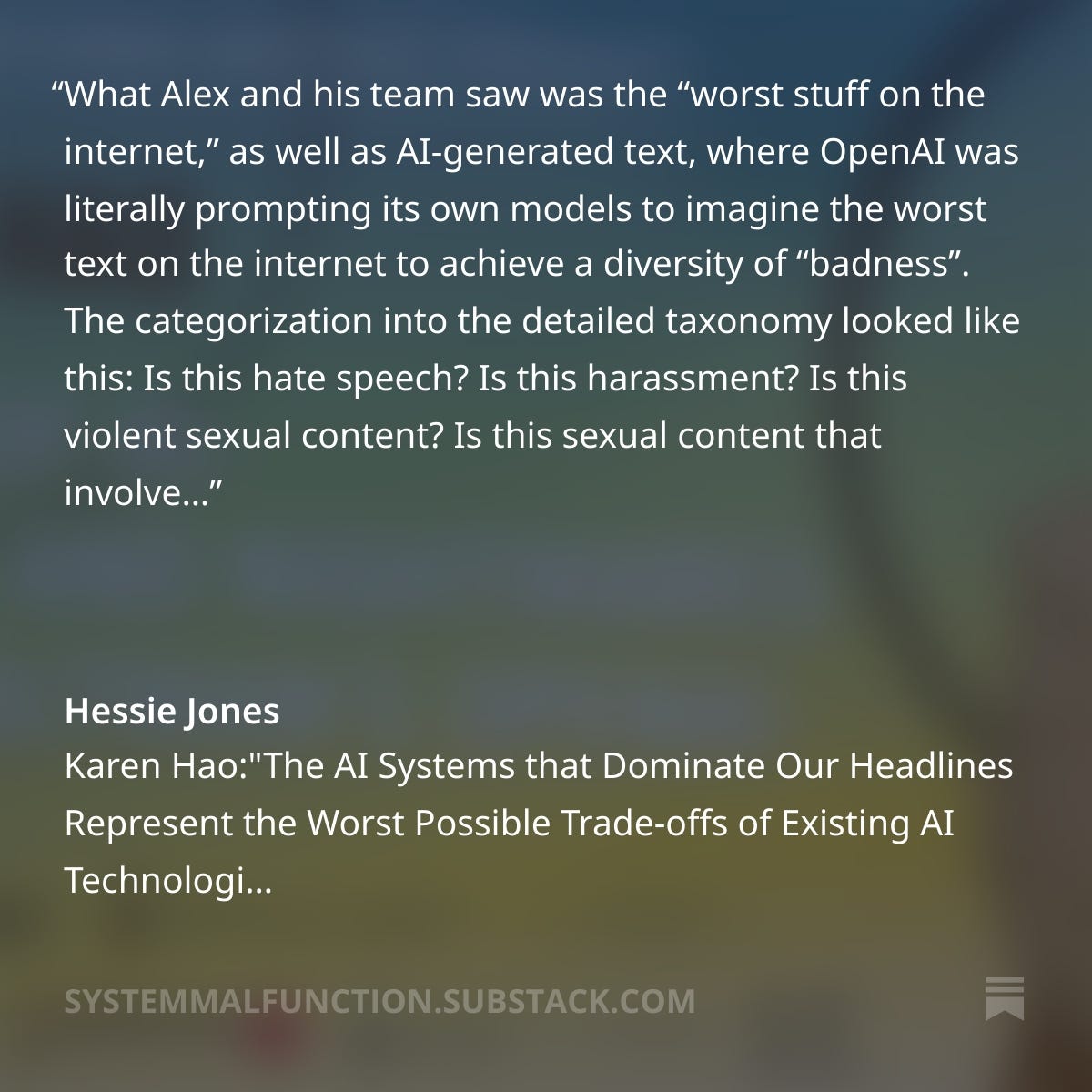
Hanna recalls the news a few years ago about Samasource, and how workers here were getting paid $2 an hour to stress test ChatGPT, and were subject to mental health issues because of the conditions they were exposed to. In a previous System Malfunction post, Karen Hao illustrates the pressures from young data annotators like Alex Cairo who worked at Samasource:
Hanna adds that one of the projects coming out of the Data Labellers Association (DLA) is to enable data workers to engage in their workplaces and inquire about working conditions. Hanna mentions a positive output from DLA was an incredible mental health event to support the staff.
AI’s Impact on Labor is Not so Clean-Cut
Hanna notes the importance of data work as a critical component in thinking about what the supply chain of AI is or what it means, adding,
This stuff[Generative AI] wouldn’t be in market if it weren’t for the labour of so many people that are at the margins… I don’t really like the term, but effectively considered to be at the periphery. And that is foundational. There are so many hands there — also a classic Mechanical Turk. It’s the person behind the curtain, and this happens in so many different guises. It happens with our chatbots. It happens with Waymo, our self-driving cars, where interventions are needed for those vehicles to go at all.
Four to six percent of the time, they don’t fully disclose those interventions… In the words of one commentator, the idea of a level-five autonomous vehicle—a classification by the U.S. National Highway Traffic Safety Administration—is still science fiction… that does not exist.
This is one element of labor in the supply chain. On the other side, Hanna points to the ways in which there’s a vision of fully automating certain jobs away, and she references the fortuitous Altman and Amodei’s statements that walked back these predictions in advance of their respective IPOs.
Hanna is clear that layoffs as a direct result of AI mean either freeing up capital assets to invest in these technologies or adopting a fire-first, try-to-make-it-work-later approach.
Oracle is an example of laying off 30,000 employees to pay for data centers.
Snowflake, a Bay Area company, gave its employees an AI mandate to use these technologies or get fired. Eventually, they laid off over 70 staff. Atlassian laid off 10% of its workforce in March, and Block laid off 40% in February — both attributed their cuts to AI.
Hanna argues that this is a common tactic of work intensification, under the guise of a technology that can do it all, adding that resistance was loudest among labor and labor organizations, which screamed for guardrails. Hanna is adamant this doesn’t mean anything, stating
It means that you believe there is a techno-social future in which there is space for chatbots, where you can put some minor directives in place.
Governance is Slow, but Data Centers May be the Catalyst for Action
Smart regulation and guardrails continue to lag. In many cases, they don’t have the necessary deterrents or enforceable fines to curtail the risks posed by these technologies.
Hanna has pointed to how it’s playing out:
Bernie Sanders has proposed an AI sovereign wealth fund where citizens get a piece of the pie.
Resources and case studies from unions who have seen the AI threats to their control in the workplace.
The labour movement has been quite conflicted about data centers. Parts of the labor movement see data centers as a labor opportunity: gas construction project is offering a way for trades, building trades, associated electricians, pipe fitters, security etc. As per Hanna, this is a "people wedge. There is this reconfiguring of the alliance, and it’s making us rethink what solidarity means and how we align with different people.”
Politically, there are conservatives up in arms about data centers. Hanna says, “They understand the carbon costs and the impending impact on electricity and hydro costs, and what the impending noise and data centre pollution will do.”
Hanna points out that there are large organizing entities: legal, environmental, data justice, data governance, AI militarization, AI weaponization. But by far, the strongest push against AI has been the movements against data centers. There are many people organizing around this one issue. For the funders of these data centers, the location opportunities are not because they would make ideal locations, but, as per Hanna, because of the regulatory gaps that minimize their business risks, adding,
And so it becomes this fight that’s around power centralization, around literal power electricity, and around the ways in which there’s a fight for land sovereignty. This question also raises the question of what the defence of data centers is… Because now, to fend off or at least split off the data center coalition, what data center developers are saying is it’s a matter of national security.
Kevin O’Leary uses this argument, “We have to beat China at AI,” to justify the big data center outside of Salt Lake City.
This is now the common mantra in favor of data center development. Hanna adds that this narrative now allows the defense industry to enter into this space in a significant way,
This was the original play in the 1950s when the original grant written for AI development was funded by Rockefeller, but then other organizations were also funding: DARPA, Office of Naval Research, IARPA etc.
And now we’re doing it backwards—funded by venture capital and defense is coming in the back door to say, ‘We want a piece of this.’
And the companies are banking on it[military] as a backstop for when the technologies don't pan out for their advertised usage, or saving costs on labor power. When that happens, they have the government contracts to lean on.
Alliances are clearly shifting, and a more informed mainstream recognizes what it means to have AI embedded in our futures.
Hanna pointed out that in New York state, coalition that included environmentalists, labor, and Indigenous organizations were effective in stopping the development of a data center site. And that has coalesced into a state-wide moratorium against data centers in NYC. Hanna proclaimed,
“That wouldn’t be happening if it wasn’t for mass protests.”
What Murphy pointed out, however, is that, for the first time in Canada, we have military funding for research and technology development. In the U.S., there has been a long-standing organization against technology and the military. The nascency of this in Canada means we don’t have the same levels of organizing intensity, hence influence, as the U.S.
Back to Regulation?
Apart from coalition-building, regulation needs to become more effective. In the U.S., this is fragmented. The federal laws on AI do little to hold tech companies accountable. In fact, it shields them. According to Hanna, the EU regulation has limitations:
The EU AI Act is like a Swiss cheese solution to many of the worst aspects of AI technologies for a few reasons. There’s a way in which the act classifies certain uses as low to high risk. The high-risk uses include things like facial recognition in law enforcement and some forms of extreme militarism. There are many exceptions to this, notwithstanding the border view. These are commonly used by Frontex, the EU border security organization, and the rights of migrants are actually nonexistent in the EU AI Act. It also relies on a standard set of protocols similar to the International Standards for Bias and Ethics. That standards-setting process is wholly corporate-owned. And so in terms of actual society, that process is very difficult. The new regulation is a pretty weak piece.
What Hanna concludes is that unions and labor organizations are very strong category structures that can push back in meaningful ways. Her experience with some of these institutions has revealed their ability to embed and convince people to change practices, and from the community, develop community governance practices around data, both infrastructure and technology.
This moment in time, this tension about a technology that yields both political, military as well as people-led and labor-led organizations is a good thing. It means the messages that Alex Hanna, Timnit Gebru, Emily Bender and DAIR are penetrating through.
In their book, Hanna and Bender’s message is that this AI hype obscures real-world harms. In their book, they write,
“Not only does the rhetoric around p(doom) distract from actual harms, but the very terminology of “artificial intelligence” impedes clear understanding of the technologies in question, what they can and should be used for, and how to evaluate them.”
After all, if we are to believe that AI is inevitable, then shouldn’t we control how it’s used, govern how it’s built, and ensure that all humans remain its central beneficiaries?